Showing posts with label Game Community. Show all posts

Tuesday, 12 December 2017

Gamer Grandma (and her Grandkids)


I was reading a paper about elderly gaming when I remembered a 60second documentary I saw once about an old lady who was a huge fan on Skyrim. You might have seen it too, as it went viral about an year ago, but if you haven't, here what I'm talking about:


I went in the comments section (if there's a video that can't attract haters is this one, right?) and I found this:


I immediately wondered: “Wait, are you telling me that she's a meme?”. I googled her and, BAM, I stumbled upon the best fanbase of the Internet. I was immediately in love.


Shirley Curry, a.k.a. Gamer Grandma, has a YouTube channel where she streams her Skyrim games (1 million views!) and, sometimes,  her treadmill strolls, some pretty good fan art and even a Steam group (that I immediately joined): GradmaShirley'sGrandkids (2631 members). The media also noticed her and wrote several pieces about her (e.g. here, here and here).

Gamer Grandma is also quite active on Twitter, and seem to bring out the best from people.


As every Grandma she's always an advice for her grandkids in distress .

By the way, she also have some rather good piece advice on how to deal with online bullying: “Older gamers leave me comments on my channel saying that they don’t even record because they’re afraid of getting nasty comments. Well, it isn’t anything to be afraid of — either ignore them or delete them! You have the power.

Wednesday, 31 May 2017

De Strijd der Robots, boardgame.
As promised I am back to SemioNerd to share some stuff about games. My dissertation is finished and will be defended bravely by me the 8th of June at my Alma Mater in Turin, Italy.
Today, however, I'll write a few lines about an interesting 1978 boardgame that I just unpacked. I can't say that I am a great fan of unboxing videos (or vicarious thrills from opening new gear). I like boxes as the next guy (I've a hidden folder full of pictures found on the Internet of my old Lego and Playmobil toys) I just do not care much about the unboxing. For this game, however, the situation was different. But let's proceed in order.

Few days ago I was in Copenhagen for the Boardgame Studies Colloquium, a rather nice event full of interesting people - scholars, game designers, collectors, game historians. In one of the sessions game designer Fred Horn dedicated his lecture to "Metropolis - Der Srtijd der Robots" a Dutch boardgame of 1978 by Jaap de Jager and R. Zielschot that Horn claims being the first real Sci-Fi boardgame ever made. The history of the design and publication of this game is complex and full of drama, truly fascinating - or so they tell me.
Yes, because (undoubtedly thanks to some Murphy's law) while Horn was giving his presentation in a room, I was in another room, giving my presentation. When I interrogated my fellow participants they gave me passionate, but vague and contradicting, reports about the game's story.
Nevertheless, even if I wasn't able to attend to the lecture I still got a copy of the game. Fred Horn got several of them from the game designer son (or something similar) and was so nice to give them away at the conference, so I got my very own.
In the next days I grew attached to the game, mainly because I has several days to spend abroad and no luggage to put it in. The game is rather large, 43x34x3 cm, and therefore I could not open the plastic wrap of the game to see what was inside, otherwise it would have been impossible to transport it around under my arm. For several days, then, I wandered in my Copenhagen hostel, in the city airport and then in Berlin and Potsdam and in the airport again all the way home with my sealed copy of Metropolis.
If my apparel indeed draw some curious looks at the check-in counters, still my curiosity of the content of the game was even stronger. So, once finally at home, first thing I did was unwrapping that damn game!


Inside it were a board with a printed map of land and see (10x10 squares of land and 5x10 squares of sea), a manual and 120 plastic figures depicting, in blue and red a set of land, air and sea vehicles with perfect 1970s style. 


The next day I decided to try it, in lack of better opponents, playing against myself. The rules of the game are rather straightforward: every player has 4 metropolises (3 on land and 1 on sea), the first one to capture two of the from the enemy wins.
The game starts by positioning all the figures on the map, that then appears rather crowded.

As the figures has different values, both in combat and for movements, I suppose that this first phase can decide much of the game and the fact that Red has to position all its figures before Blue might be an advantage for the latter. I'm still too new to the game to say it for certain, though.
Once the battlefield is filled with figures each turn players can move one figure on the board. This might seem slow, but in fact it's quite intriguing, as the players has to fight contemporarily on several fronts, without loosing track of their troops. As I played alone, I ended up resolving the sea battle first, and only when Red had an undisputed control of the eastern part of the map I proceeded to continue the battle on land.
The game, mutatis mutandis, often feels similar to chess: several situations of stale are formed, in which the first one to move one of its pieces will loose the confrontation. Protecting one most powerful units bu moving them cautiously and always protecting the square they are in, might be an unavoidable part of every winning strategy.
Several times I had the feeling that there were too many useless figures, too weak to confront the stronger ones, that were just occupying space or be destroyed in series by the artillery. Again, this might be a flaw of my playing and not of the game, only time will tell.
After more or less half an hour of play Red lost all its heavy tanks and was therefore unable to win the game. After keeping Blue in check for some time, its defence failed and two of its metropolises were occupied. 


The overall gameplay is rather smooth and fun, a part for some time spent checking the rulebook trying to figure out which figure moves in which way (there are 26 different types of them). It has a nice retro taste, without the poor rule design that was unfortunately pretty common at the time. The art is also pretty nice and goes well with the retro-sci-fi theme (maybe we need a word for that, like for steampunk? Or it already exist?).
Next objective: play with someone else than me, myself and I!

Friday, 4 December 2015

From the Strong with love:
a month at Rochester's museum of Play.


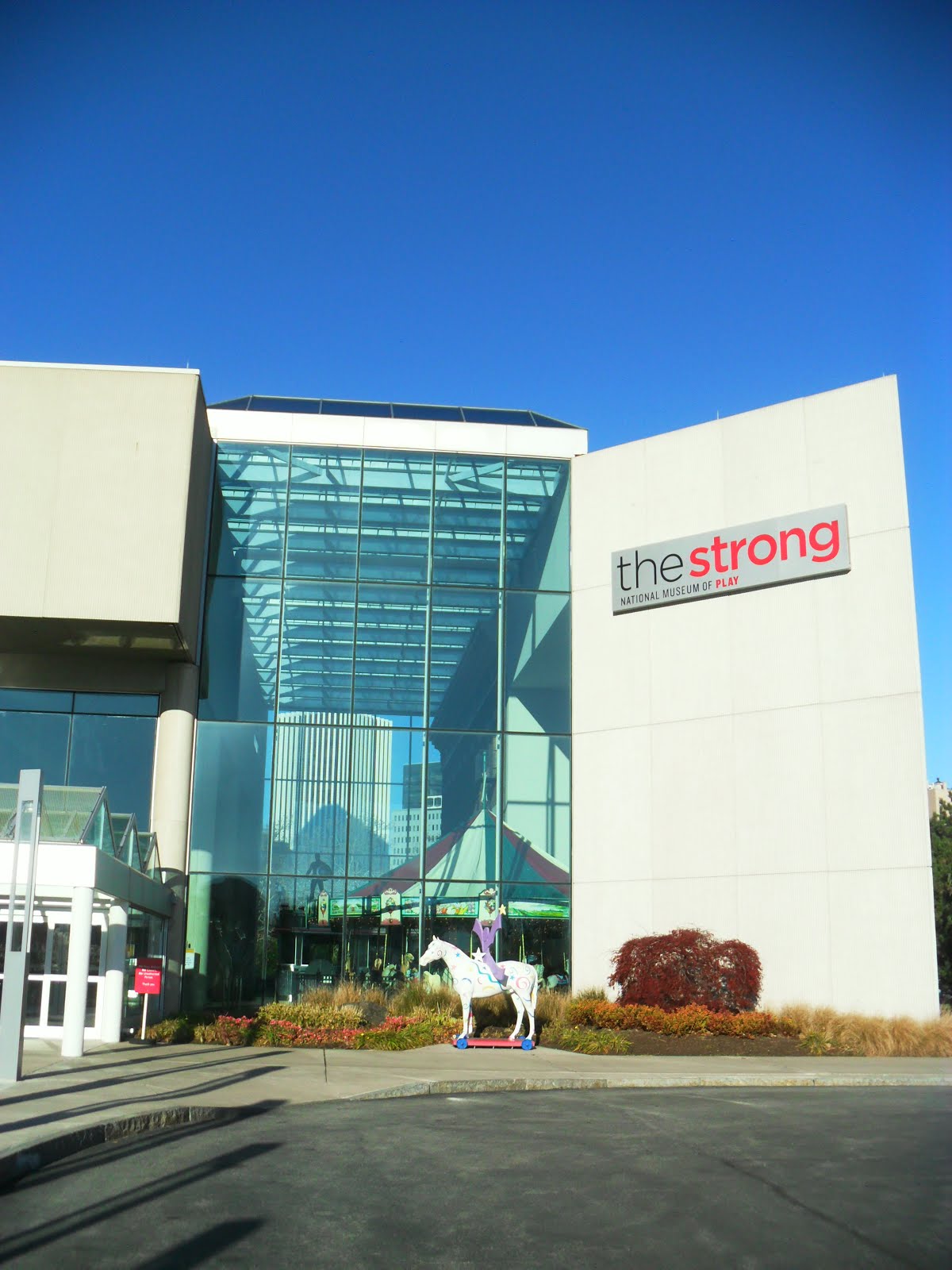
Since November the 16th I have the pleasure of working on my researches in a wonderful and rich environment: The Strong Museum of Play
The museum was founded in 1968 by Margaret Woodbury Strong, a prolific collector of everyday objects, especially dolls and toys, and today encompasses almost 10000 m2 of exhibitions, the International Center for the History of Electronic Games, the National Toy Hall of Fame, the Brian Sutton-Smith Library (where I spend most of my time) and Archives of Play, the Woodbury School, the American Journal of Play, and  an awesome (alas not open to the public) warehouse full of toys, boardgames and artifacts, with an uncanny resemblance to the Indiana Jones' warehouse...

The Strong also offers three research fellowships, among which the "The Strong Research Fellowship" which I was honoured to be awarded with. 
The project I'm working on – which will be part of the PhD dissertation – aims at investigating the relationship between toys and meaning, focusing in particular on three different dimensions of the way this artefacts operate in a semiotic level: 
-The intentio auctoris: how toy makers, designers and companies try to and actually convey knowledge, meaning and cultural values through their creations; 
-The intentio lectoris: the semiotics aspects of the actual toy-play, that goes far beyond what the authors have imagined (see Sutton-Smith 1986) and make use of toys as means of self expression (see the works of Winnicott and Erikson) or as instruments to explore the world, both physical and semiotic. 
-The intentio operis: how the physical characteristics of these artefacts are able to influence and direct the way they are used and interpreted (see the works of Latour and Verbeek). 
A meaning-centered approach to toys, combining these three points of view, should be up to the task for an in depth analysis on toy-playto place side by side with those proposed by developmental psychology and social sciences. 
The topic, as some of you may know, isn't completely new to me, but the opportunity of analysing extensively different kinds of toys and toy catalogues, here at The Strong, is being fundamental for the advancement of the research! 


Thursday, 16 July 2015

Media Mutations 7 Videos
 
The videos of all the papers and keyword speeches of MM7 are available here.
You can see many presentations, among which Geoffrey Long's, Tanya Krzywinska's, Ivan Veturi's and, of course, mine ;) .
The registration confers to all of us a very funny "s", which may be distracting 'cause it's kind of funny. The contents are really interesting thought.
 

Monday, 25 May 2015

Media Mutations 7 in Bologna.


Tomorrow I'll be in Bologna for Media Mutation 7 annual international meeting dedicated to communicative evolution. This year edition, entitled "Space Invaders. The impact of digital games in contemporary media ecosystems" seems to be perfect for my Lotmanian, semiotic approach! I prepared a bunch of colorful slides to make my semiotics more sexy and I'm ready to go! :)
I'll be glad to visit again the city of Towers (how is it possible that there is no Assassin's Creed set in Bologna? It would have been perfect! Well, in the meantime we have this, currently in kickstarter!).
I've to admit that I'm also quite exited to hear our keynote speakers, Tanya Krzywinska and Geoffrey Long (Peppino Ortoleva, in charge of the final remarks, is also very good, but I have the chance to see him quite often!).
I'm looking forward also to meet Gabriele Ferri - possibly the first "semiotician of video games" in the world - which since now I've only met on Skype...

Anyway, here you can find the program of the conference. My presentation (and my colorful slides) will wait you here in a couple of days!


Thursday, 30 April 2015


Conspiracy Theories and Semiotics of the Web.

This year's "Meetings on Meaning", the semiotic conferences organized by the CIRCe (Interdepartmental Center of Research on Communication) and held at the University of Turin, are dedicated to conspiracy theories.

 [Click here for the program]

The record of all the meetings already held are available (in HD!) on the Lexia (International Journal of Semiotics) channel on youtube. Most of them are in Italian, but there is some in English too, so it's worth to check...

In any case, here you can find my lecture, dedicated to conspiracy theories in the periphery of the semiosphere of the web (i.e. all those sites like 4chan and 8chan) and a case study on the GamerGate controversy. I hope you enjoy it!


Monday, 1 September 2014

The (Un)deniable link between Videogames and Violence.

A truth-speaking comic by MercWorks and Andrew Bridgman.

Saturday, 23 August 2014

#welovegamedevs!
Hard times for game devs... after the whole (very sad) Zoe Quinn affair, only few days ago Polygon reported that “game dev harassment remains as bad as it was a year ago”, when it seemed to reach a fevered pitch. The International Game Developers Association is now creating a special interest group to investigate mental health, even if it decided against support groups. Kate Edwards, the executive director of IGDA said: “We are also exploring methods by which we can educate game players on how they can and should interact with developers”.
Yesterday, on twitter the hashtag #welovegamedevs become trending and thousands of gamers used it to underline their love and appreciation for the developers of their favorite games. The hashtag has been launched by Keith Stuart of The Guardian, who wrote “Maybe everyone should think of a game they really love then tweet the developer and tell them. Tag it #welovegamedevs (I know I'm a hippy)”. The initiative immediately found the support of many and echoed through the internet (see e.g. Gamasutra, Dual Shockers and Crave online). #welovegamedevs become trending, first in the UK and than in the US, showing the best side of the game community and, incidentally, making Keith Stuart cry : “Do you think we can get #welovegamedevs trending? If we do, we win today! (You will also see a grown man cry a bit)”.
PS
If you didn't do it yet, look up at these tweets, both from gamers and grateful developers, it is a “faith in humanity restored” sort of thing!