Showing posts with label Toys. Show all posts

Wednesday, 4 May 2016

JangoTravels


I know I should be writing my dissertation, right now, instead of playing with photoshop. But today is a nerd festivity, May the Forth - keep it holy - and therefore the perfect occasion to launch some silly projects about Star Wars.
So, well, here it is: JangoTravels a microblog dedicated to our favourite bounty hunter and to his travels around the galaxy. 
Toyrism is a new, extremely nerdy, trend that consists in bringing some toys along, when you travel, and take pictures of them. I stumble upon this phenomenon while reading Kati Heljakka's wonderful work on toys and adult play and I thought it was exellent. And... yep, it looks definitely like something we saw in Le Fabuleux destin d'Amelie Poulain...

I decided to mix this idea with another of my passions: miniatures. I always liked the resemantisation that happens when you deal with small scale objects. If you place a toy, a miniature, on ground and you look at the room from its perspective, the world will look like a pretty weird place. Table legs will become columns or towers, the carpet a forest (as Sir Terry Pratchett thought us) and so on. It is a playful practice, but also deeply semiotic - as it deals with the meaning that we give to everyday objects.
The child of these two passions is JangoTravel, where I put together my poor knowledge about photography, my poor skills with photoshop, a couple of Star Wars spaceships from Micro Machines and a lot of stupid hashtags.
Don't know about you, but I'm having fun.

May the 4th be with you !


Friday, 22 January 2016

From the Strong part II: images of play.


One of my favourite part of my stay at the Strong - which is also the main reason of my visit - is the opportunity to handle play-related fascinating artifacts, some of which pretty ancient, and almost all extremely interesting.
With the permission of the museum I decided to share with you some pictures of the most interesting artifacts I come in contact with in these days.

Catalogs.
As all the non-exposed toys are in the awesome, but not easy-to-access, warehouse I told you about in the last post, I worked a lot with toy catalogs, that have the advantage of showing a vast sychronic set of toys and, on the other hand, to carry with them a series of paratextual indications that can say very much about how people used to think about toys.

One of my favourite catalogs is the Illustrated catalogue of soft and hard rubber goods, dating 1869 (!) 
Here a picture of the cover:


This catalog was clearly aiming at rich people (one of the internal advertisement referred to Napoleon the 3rd!) and reflected their customs and their fashion. The lead toys in teh catalog are undoubtedly dolls: baby dolls, adult dolls, dressed, naked, black and white, jointed and not and sometimes limited to doll heads. Probably 19th century girls, like an army of little drs Frankensteins, used to decapitate their dolls to change their heads. Not so different from what we do to Lego figures, but still, when dolls are involved its easy to slide down the uncanny valley.

Another ancient and fascinating catalog is Tinker Toys catalog from 1936. Tinker toys were extremely popular -with more than a million set sold - especially in the first half of the 20th century. The catalog, although simple, is very picturesque and cute, a little treasure.


This is why it has been a little bit sad to find this announcement in another Tinkertoy catalog a few year younger:
 
In accord with the conservation of material and manpower, the Tinkertoy Line for 1942 has been brought down to four prime Construction Sets, for which supplies are still available. There are illustrated on the following pages.
Because copper, brass and steel are under priority rulings, the the Tinkertoy Spring and Electric Motor outfits have necessarily been discontinued. (…)
Due to generally increased cost, it has not been possible to maintain the old scale of prices. The revised figures, as shown on the current lists are, under prevailing conditions, the low at which Tinkertoys can be made and sold.” 


 War doesn't spare toys, apparently.


On the other hand Toys still like war, or at least they like to represent it, as it is clear from this picture from Sears Christmas book 1956.


In the years after the war there has been a boom of war-related toys, allowing children to explore the new myth (as Roland Barthes would call it) that had become so important in western cultural narrations.
If someone still shrink at the idea of "war toys" (and unfortunately many people still do), they should keep in mind what Sutton-Smith himself claimed, that: toys as such do not dominate play, "rather, the toys are transformed by the experienced players to suit their own imaginative convenience. The toys are an agency for imagination; the do not make the imagination their victim as is implied in much intellectual prejudice.” (Toy as Culture, p. 204).


Another jewel of The Strong collection is the first Lego catalog ever published in America. Samsonite had been charged by Lego to produce their toys on the other side of the Atlantic Ocean, and a manual presenting Lego was published to introduce the European toy to American toy-shops owners.


Being a big Lego fan myself (I've also published a short critical note on them, this year) I was quite exited to have this item in my hands.


Toys.
The collections storage of the Strong, as I already told in last post, is full of treasures, a real Ali Baba's cavern, a Paese dei Balocchi (Pinocchio Toy Land).
I've had the occasion to spend some entertaining hours down there, guided by fantastic Chistopher Bensch (the Vice President for Collections of The Strong) and to see - and photograph - many interesting items.

The hugest collection I saw it was probably the Barbie on, counting something like 2500 single pieces.
Some of the where pretty funny, like this Oreo Barbie...


What's about these biscuits anyway? I don't think that they are that good, but OMG there are any kind of products dedicated to them!

Another interesting doll it this prophetic looking Barbie for President 2000:
 
Doesn't she look like Hillary? :P
In any case, I was pleased to see that there is a "presidential" version of Barbie for every election - even if, apparently, she never wins...


Among all the Barbie I saw, however, ma favorite is this one:


It's not because she is disabled, but I genuinely think that she's the most friendly looking of all (and the best dressed too...).


The other collections I focused on were the Fisher price collection (you can see here a beatuful ancient wooden circus set) and the Donald Duck collection.


Finally, even if I was supposed to focus on toys, my geekness exploded in sight of the wonderful Andrew Cosman-Mary Valentine Game Collection comprehensive of more than 600 war, strategy, and other types of complex games: a true nerdgasm. I gave up immediately any resistance and just started to look at all those amazing games jumping up and down as a little boy in a toy store...


This collection has also its own fellowship so I'm seriously considering the idea to apply for a next round at The Strong, just to focus on strategy games... Rochester isn't around the corner, that's also true, but I guess I'd be willing to cross the ocean for 600 wargames! =)


Friday, 4 December 2015

From the Strong with love:
a month at Rochester's museum of Play.


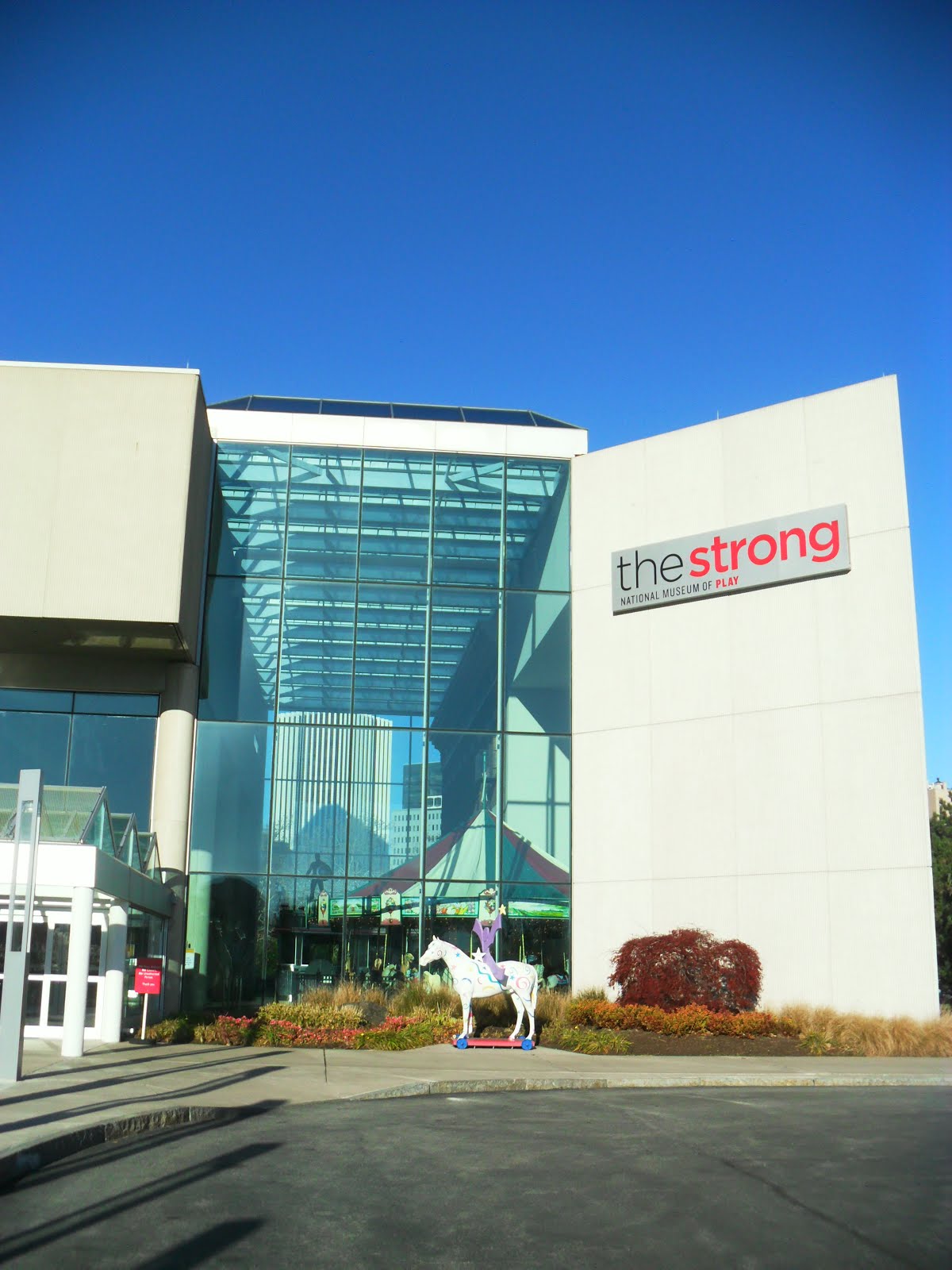
Since November the 16th I have the pleasure of working on my researches in a wonderful and rich environment: The Strong Museum of Play
The museum was founded in 1968 by Margaret Woodbury Strong, a prolific collector of everyday objects, especially dolls and toys, and today encompasses almost 10000 m2 of exhibitions, the International Center for the History of Electronic Games, the National Toy Hall of Fame, the Brian Sutton-Smith Library (where I spend most of my time) and Archives of Play, the Woodbury School, the American Journal of Play, and  an awesome (alas not open to the public) warehouse full of toys, boardgames and artifacts, with an uncanny resemblance to the Indiana Jones' warehouse...

The Strong also offers three research fellowships, among which the "The Strong Research Fellowship" which I was honoured to be awarded with. 
The project I'm working on – which will be part of the PhD dissertation – aims at investigating the relationship between toys and meaning, focusing in particular on three different dimensions of the way this artefacts operate in a semiotic level: 
-The intentio auctoris: how toy makers, designers and companies try to and actually convey knowledge, meaning and cultural values through their creations; 
-The intentio lectoris: the semiotics aspects of the actual toy-play, that goes far beyond what the authors have imagined (see Sutton-Smith 1986) and make use of toys as means of self expression (see the works of Winnicott and Erikson) or as instruments to explore the world, both physical and semiotic. 
-The intentio operis: how the physical characteristics of these artefacts are able to influence and direct the way they are used and interpreted (see the works of Latour and Verbeek). 
A meaning-centered approach to toys, combining these three points of view, should be up to the task for an in depth analysis on toy-playto place side by side with those proposed by developmental psychology and social sciences. 
The topic, as some of you may know, isn't completely new to me, but the opportunity of analysing extensively different kinds of toys and toy catalogues, here at The Strong, is being fundamental for the advancement of the research! 


Friday, 28 November 2014

Like our Forefathers Played:
Traditional Play & Toy's Substance of Expression.

The talk I presented to the annual meeting of the Italian Association of Semiotic Studies is now available on-line!
Another step toward a semiotic theory of toys... ;)

Wednesday, 29 October 2014

Annual Conference of AISS.

The annual meeting of the Italian Association of Semiotic Studies has just been held in Teramo (near Rome).
We had three days of conferences about Nature and Authenticity with the participation of many important scholars among which Umberto Eco himself!

In the congress I had the chance to meet two of my favorite academic authors: Patrick John Coppock and Paolo Bertetti.
Coppock is a very prolific philosopher and semiotician, you can check this paper too see from yourself how interesting is the stuff he writes!
Bertetti wrote a book on the intertextual and transmedia character Conan the Barbarian. This work will be one of the pillar upon which I'm struggling to build my PhD thesis!

I myself have presented a paper on the materiality of toys (soon on #SemioNerd) as part of University of Turin's Atelier. As always working in close contact with them has been informative and engaging!


Here a picture of some of the members of the Atelier from Turin.

Thursday, 9 October 2014

The Video of "Toward a Semiotic Analysis of Toys" now on Youtube.

Here the video of the presentation I gave in Sofia last Septmeber, official beginning of my work on semiotics of toys...


Next step: a semiotic analysis of the substance of expression of the toy-language that I'll present in Teramo at the annual congress of the Italian Association of Semiotic Studies (AISS).

Monday, 25 August 2014

Brickfilms: Cinema, Space and Lego.
Since the beginning cinema has been fascinate by space: it is known that the first movie ever has been Le voyage dans la Lune by Geroge Méliès.

Less known is that also the first brickfilm (you know, Lego stop-motion videos) treats of the same topic. For an exceptional coincidence 1973's En rejse til månen has the very same title, just in Danish. Twelve years old Lars Hassing and his brother Henrik realized it for their grandparents golden wedding anniversary and were influenced by the Apollo program. Apparently they even went up to and showed it to Godtfred Kirk Christiansen, who, in sign of appreciation, rewarded the lucky kids with large Lego sets.

Coincidences, however, aren't over. The second ever birckfilm is Lego Wars by Fernando Escovar. It was inspired by a trendy movie of the time: Star Wars. The displayed minifigures hold medieval weapons and the spaceship is truly a Red Cross helicopter: Star Wars Lego sets weren't available at the time. 

That's the thing, though, Fernando would maybe have been surprised to know that nineteen years later Star Wars would become the first ever licensed theme featured in Lego.
Benny approves! 


... and so does Vader!

Thursday, 17 April 2014

Factories of Nothing.
Yesterday night I was very tired working on my Russian test. I needed to rest a little, so I went in the kitchen, looking for a beer. I found the beer and my flatmate too. After a few chatter he showed me this:


Such beauty! Oh, marvelous factory of nothing made out of Lego, I would stare at you for all the night (instead that studying Russian)! I started to imagine an u/dis-topic future in which Lego will become the fundamental resource of humanity. Houses, cars, computers, all made of Lego. All integrable, upgradeable and mixable! Maybe the Lego shoes can be problematic (not to mention the Lego underwear), but who cares this would be an incredible technological breakthrough! There would be no garbage, because the package of your food can become the upgrade of your car or, if you eat a lot, a new floor for your house. Old Lego could be melted and forged into new Lego in an happy circle of wealth and economic growth! After the American dream we could live the Legoland dream. So let's sing it all together: <Everything is awesome!>...

Monday, 14 April 2014

LEGO!
I watched Lego The Movie with absolutely no expectations. Oh, yes, I used to love playing with my legos as a child (well, not only as a child to be honest) but the movie? Whats the point?
Films inspired by videogames doesn't work very well, in general, and film from boardgames doesn't work at all! How could a film on toys work? Ok, Toy Story come out pretty good, but it was about toys not on some real-life toys. What story could they tell?
I watched the movie anyway, in part out of curiosity, in part because I wanted to write an article about it despite its quality.
The film starts with some weird Lego guys in a fantasy-like world arguing about fake prophecies. One of them doesn't even look like a real Lego. Ok, I told myself, two hours will be spoiled. Then the scene is set in the utopic society of Lego City, in which anyone is happy and work happily all day singing the last pop tube “Everything is awesome”. And it is, awesome. It was one of the cruelest parodies of today society that I've seen in a long time, focusing on politics, media and society. It portraits a world governed by President Business in which dumb TV shows and smart agenda setting avoid people to think, or understand, too much. A strong dose of pop music, always the same song, makes everybody happy.
That's not a movie for children, not even for every adult in fact. The story turn out to be about the struggle between anarchy and order in the Lego worlds, between who follow the instructions and who prefers creativity. It's far deeper that I thought and it was really enjoyable on different levels.


And, of course, there is another thing. One of the characters was exactly the firs lego that I ever owned when I was like six years old. The space pilot, with the suit completely blue and the broken helmet without visor, identical to my memories. You can't ignore him when an old friend appears on the screen, something happens. I think the authors were pretty good in finding references shared between any Lego player, e.g. the relics, the objects that inevitably are lost in your Lego box, like coins, elastics or patches, or the very dark gray bricks that you're forced to use when you run out of black ones.
Now, if you excuse me, I have to go in the cellar looking for some of my old friends...